
This is new!
Once a month, and until we’ve gone through all the job profiles (spoiler alert: there are 68 of them), the HR department will be showcasing a different role within the company.
The idea? To use staff job descriptions to detail and highlight their roles, skills and abilities.
Let’s dive into the first role on our list: the cable fitter.
What does the role of a cable fitter involve?
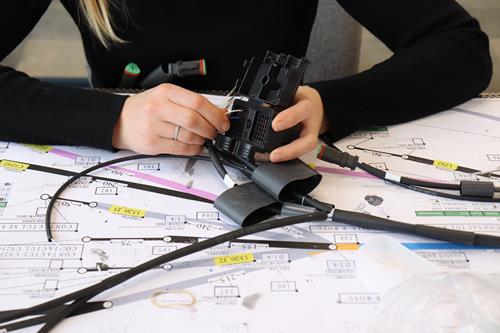
The cable fitter is responsible for carrying out installation, assembly and cabling work on industrial electrical and (where applicable) electromechanical equipment in accordance with production orders (PO) and production requirements, whilst adhering to cost, quality, deadlines and EHS (Environment, Health and Safety) requirements.
What are the key tasks for a cable fitter?
Firstly, it should be noted that there are two levels of cable fitter: Level I and Level II.
For Level I, the role involves analysing customers’ drawings and electrical diagrams to select components, identify them and implement layout or cabling modifications, in the event of any anomalies, in order to carry out preparatory work (soldering, crimping, drilling, cable cutting), where necessary. The cable fitter will then carry out the assembly and wiring of electrical/electromechanical products (wiring harnesses, switchboards, chassis and enclosures).
Key tasks associated with Level II include defining layouts in the absence of technical documentation, shaping copper bars (cutting, bending, drilling) using specialised machinery, and the assembly, fitting and wiring of high-current electrical/electromechanical products or prototypes. At this level, the fitter/cable fitter may also troubleshoot faulty components at customers’ premises or in the workshop and answer technical queries from production teams (operators, fitters/assemblers and cable fitters).
What technical skills are required?
Proficiency in using electrical measuring instruments, handling techniques and postures, the use of hand tools and power tools (electric saw, drill, screwdriver, etc.), and crimping techniques.
What professional skills do cable fitters need?
Cable fitters must be able to integrate into the team and demonstrate a cooperative attitude, be willing to travel to customer sites, and possess good manual dexterity and keen eyesight. Finally, they must be meticulous and organised.
In figures:
Of the 232 people employed by the AMPERE Group (in France only), 24 are cable fitters.
There are 8 women and 16 men.
Ten cable fitters are based in Chiché and 14 in Brégnier-Cordon.
Follow our news
Find the latest news about the group here: trade fairs, events, teams, projects and highlights.

Who am I, in terms of my role? #ERPManager
Because living and working together also means knowing what others do, what they are going…

Who am I, in terms of my job? #design-office technician
Because living together also means knowing what others do, what they’re going through, understanding their…

"La Place de l'Emploi" Forum
At the start of the new academic year, AMPERE will be taking part in the…

Gender Equality Index / CFCA
Since 1 March 2020, companies with 50 or more employees have been required to report…